
Category: Weight Loss
Reading time: 10–12 minutes
Primary keyword: how to lose weight without losing muscle
Secondary keywords: lose fat without losing muscle, preserve muscle during weight loss, muscle preservation, protein for weight loss, resistance training for weight loss, fat loss, body recomposition
Last updated: August 2026
The Goal Isn’t Just to Weigh Less
If you’re trying to lose weight, it’s natural to focus on the number on the scale.
But there is a more important question:
What exactly are you losing?
When body weight decreases, the change can come from several sources, including body fat, water and lean tissue. Some loss of lean tissue can occur during significant weight loss, which is why simply making the scale move downward isn’t the whole story.
The better goal is to reduce excess body fat while preserving as much muscle and strength as possible.
Recent research supports this approach. A 2025 systematic review and meta-analysis found that adding resistance exercise to dietary weight loss helped protect fat-free mass, increased fat-mass loss and improved muscular strength compared with dietary weight loss alone. citeturn0search8
And a 2026 meta-analysis of 20 randomized controlled trials found that lean mass represented a meaningful proportion of total weight lost during both incretin-based treatment and lifestyle interventions. The most favorable profile in that analysis was seen when lifestyle intervention included resistance training. citeturn2view2
So, how can you lose fat without unnecessarily sacrificing muscle?
Let’s break it down.
Quick Answer: How Do You Lose Fat Without Losing Muscle?
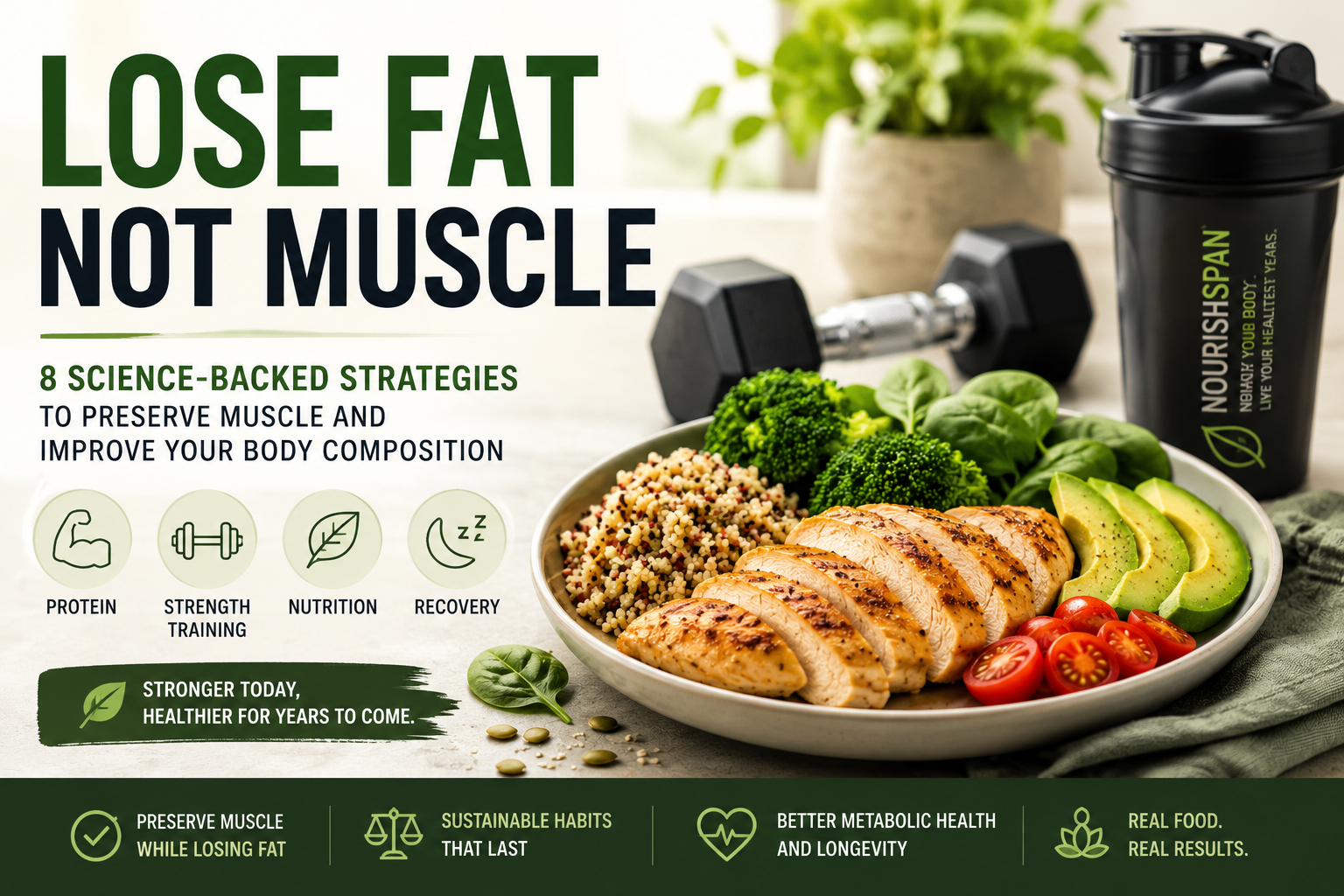
To create better conditions for fat loss while preserving muscle, focus on eight fundamentals:
- Create a sustainable calorie deficit
- Prioritize adequate protein
- Include resistance training
- Eat plenty of nutrient-dense, fiber-rich foods
- Avoid extreme or crash diets
- Stay physically active
- Prioritize sleep and recovery
- Track more than your body weight
There is no single food, supplement or workout that guarantees muscle preservation.
The strongest approach is a combination of nutrition, resistance training, adequate recovery and a sustainable rate of weight loss.
🔬 What the Evidence Says
Weight loss through calorie restriction can reduce both fat mass and fat-free mass.
The important point is that the composition of your weight loss matters.
A 2025 systematic review of randomized controlled trials found that resistance exercise during dietary weight loss protected against loss of fat-free mass and increased fat-mass loss, while also improving muscular strength. citeturn0search8
Another recent systematic review and meta-analysis involving 34 randomized controlled trials found that adding exercise to calorie restriction reduced losses of fat-free mass compared with calorie restriction alone, with strength training appearing particularly beneficial. citeturn1search11
The practical takeaway: don’t think only about losing pounds or kilograms. Think about improving your body composition.
1. Create a Sustainable Calorie Deficit
Fat loss requires your body to use more energy than it receives over time.
But there is an important distinction between creating a calorie deficit and creating an extreme calorie deficit.
Eating dramatically less may make the scale drop quickly, but faster isn’t automatically better—especially if your goal is to preserve muscle, strength and long-term health.
The CDC recommends gradual, steady weight loss and notes that people who lose weight at roughly 1–2 pounds per week are more likely to maintain the loss than those who lose weight more rapidly. Individual needs and appropriate rates can vary, however. citeturn2view3
What to do
Instead of asking:
“How little can I eat?”
ask:
“What is the smallest sustainable change that can help me lose excess body fat?”
Your calorie needs depend on factors such as body size, age, sex, activity level, medications and health conditions.
If you have a medical condition, are pregnant or breastfeeding, have a history of an eating disorder, or take medication that affects weight or appetite, speak with a qualified healthcare professional before making major dietary changes.
2. Prioritize Protein
Protein plays an important role in maintaining and building muscle.
This becomes particularly relevant when you’re eating fewer calories.
Research on adults with overweight or obesity indicates that increasing protein intake during weight loss can help support the preservation of muscle mass, strength and physical function. citeturn1search7
But there is no universal protein number that is perfect for everyone.
Your needs can vary depending on:
- body size
- age
- activity level
- resistance-training experience
- overall diet
- health status
- degree of calorie restriction
What to do
Rather than trying to eat an enormous amount of protein in one meal, build meals around a quality protein source.
Examples include:
- Eggs
- Greek yogurt
- Cottage cheese
- Fish
- Chicken
- Lean meat
- Tofu
- Tempeh
- Beans
- Lentils
- Edamame
You don’t necessarily need protein supplements. Food can provide plenty of protein for many people.
If meeting your protein needs through food is difficult, a protein supplement can be a convenient option—but it should complement your diet rather than replace a balanced eating pattern.
NourishSpan tip
Think of protein as an anchor for your meals, not as the entire meal.
Pair it with vegetables, fruit, whole grains, legumes or other high-fiber foods to create a more satisfying and nutrient-dense plate.
3. Make Resistance Training a Priority
If you want your body to hold on to muscle during weight loss, give your muscles a reason to stay.
That’s where resistance training comes in.
Resistance training includes activities such as:
- Weight lifting
- Resistance bands
- Bodyweight exercises
- Machines
- Other exercises that challenge muscles against resistance
A 2025 meta-analysis found that resistance exercise during dietary weight loss protected fat-free mass and improved muscular strength compared with diet alone. citeturn0search8
What to do
If you’re new to resistance training, start with a manageable routine that trains the major muscle groups consistently.
You don’t need to begin with complicated workouts.
A simple routine might include movements such as:
- Squats or sit-to-stands
- Hip hinges
- Rows
- Push-ups or chest presses
- Overhead presses
- Lunges or step-ups
Start at an appropriate level and gradually increase the challenge as your strength improves.
If you have injuries, significant health conditions or you’re unsure how to perform exercises safely, consider working with a qualified exercise professional.
4. Eat More Fiber-Rich, Nutrient-Dense Foods
Protein gets a lot of attention during weight loss, but fiber deserves a place beside it.
Fiber-rich foods can help make meals more satisfying while providing vitamins, minerals and other beneficial compounds.
Good sources include:
- Vegetables
- Fruits
- Beans
- Lentils
- Whole grains
- Nuts
- Seeds
What to do
Instead of trying to remove as many foods as possible, think about what you can add.
For example:
Instead of:
A small meal based mainly on refined carbohydrates.
Try:
Protein + vegetables + a fiber-rich carbohydrate + a source of healthy fat.
This approach makes your meals more nutrient-dense without requiring extreme restriction.
And it creates another important connection for the NourishSpan approach:
Nutrition → Satiety → Weight Management → Metabolic Health
5. Avoid Crash Diets
One of the biggest mistakes people make is assuming that the faster the weight comes off, the better.
That’s not necessarily true.
Very restrictive diets can be difficult to maintain and may make it harder to consume enough protein, vitamins, minerals and other nutrients.
The CDC specifically warns against unrealistic weight-loss goals and emphasizes sustainable habits rather than extreme short-term targets. citeturn2view3
Instead of:
“I need to lose 20 pounds as quickly as possible.”
Try:
“I want to build a way of eating and moving that I can maintain.”
This may sound less exciting.
But sustainable progress is much more valuable than a dramatic result that disappears a few weeks later.
6. Keep Moving Outside the Gym
Resistance training is important for muscle preservation, but daily movement matters too.
Walking, cycling, swimming, household activities and other forms of movement can contribute to energy expenditure and overall health.
You don’t need to turn every day into an intense workout.
What to do
Look for opportunities to move more:
- Take a walk after meals.
- Use the stairs when practical.
- Take short movement breaks.
- Walk while talking on the phone.
- Spend less time sitting continuously.
- Choose activities you actually enjoy.
The CDC includes regular physical activity as part of a healthy approach to weight management. citeturn2view3
Think consistency, not punishment.
7. Don’t Underestimate Sleep and Recovery
Weight management isn’t only about food and exercise.
Sleep, stress and recovery also influence how sustainable your lifestyle is.
The CDC includes adequate sleep and stress management among the lifestyle factors that support healthy weight management. citeturn2view3
When you’re exhausted, maintaining good nutrition and exercise habits can become considerably harder.
What to do
Create a realistic sleep routine.
Try to:
- Keep relatively consistent sleep and wake times.
- Reduce stimulating activities before bed.
- Create a dark, comfortable sleeping environment.
- Give yourself enough time to sleep.
- Address persistent sleep problems with a healthcare professional.
You don’t need a perfect lifestyle.
You need a lifestyle that allows your body to recover.
8. Track More Than the Scale
The scale is useful.
But it doesn’t tell you everything.
If your goal is to lose fat while preserving muscle, consider monitoring several indicators.
| What to track | What it can tell you |
|---|---|
| Body weight | Overall weight trend |
| Waist measurement | Changes in abdominal size |
| Strength | Muscle performance |
| Progress photos | Visual changes |
| How clothes fit | Changes in body size |
| Body composition | Estimated fat and lean mass |
Body-composition measurements can be useful, but methods vary in accuracy and shouldn’t be treated as perfect.
The key idea
Don’t let one number determine whether you’re succeeding.
If your waist is getting smaller, your strength is stable or improving, your clothes fit differently and your overall health habits are improving, the scale is only one part of the story.
The Muscle-Preserving Weight Loss Formula
Think of your approach as a system:
Sustainable calorie deficit
Adequate protein
Resistance training
Fiber-rich, nutrient-dense foods
Daily movement
Quality sleep
=
Better conditions for losing body fat while preserving muscle
There is no guarantee that someone will lose exclusively fat.
The goal is to minimize unnecessary lean-mass loss while achieving sustainable fat loss.
Fat Loss vs. Weight Loss: What’s the Difference?
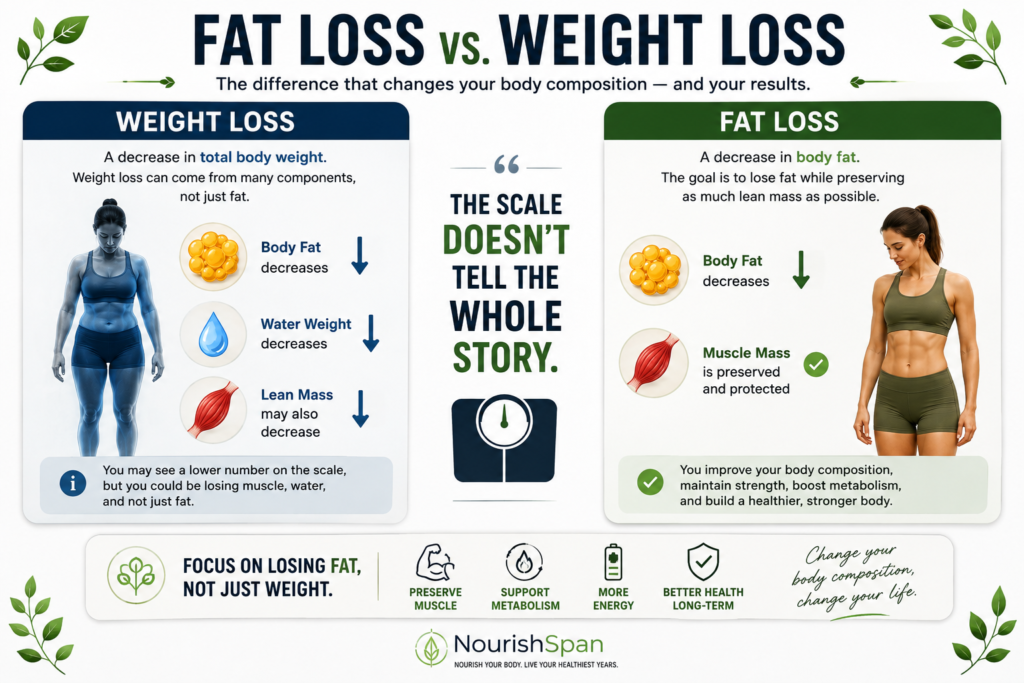
These terms are often used interchangeably, but they aren’t exactly the same.
Weight loss refers to a decrease in total body weight.
Fat loss refers specifically to a reduction in body fat.
Your body weight can change because of:
- Body fat
- Muscle and other lean tissue
- Water
- Glycogen
- Food in the digestive system
That’s why a sudden drop on the scale doesn’t necessarily mean you’ve lost the same amount of body fat.
And the opposite is also true.
You can sometimes see relatively little change on the scale while your body composition improves.
This is one reason body recomposition is such a useful concept.
Can You Build Muscle While Losing Fat?
Sometimes.
This is generally referred to as body recomposition.
Whether someone can gain muscle while losing fat depends on many factors, including training status, nutrition, starting body composition and individual circumstances.
People who are new to resistance training or returning after a period away may have more opportunity for simultaneous changes than highly trained individuals.
But it’s important not to turn body recomposition into another unrealistic promise.
For many people, the most realistic goal during a weight-loss phase is:
Lose excess fat while preserving as much muscle and strength as possible.
What About Cardio?
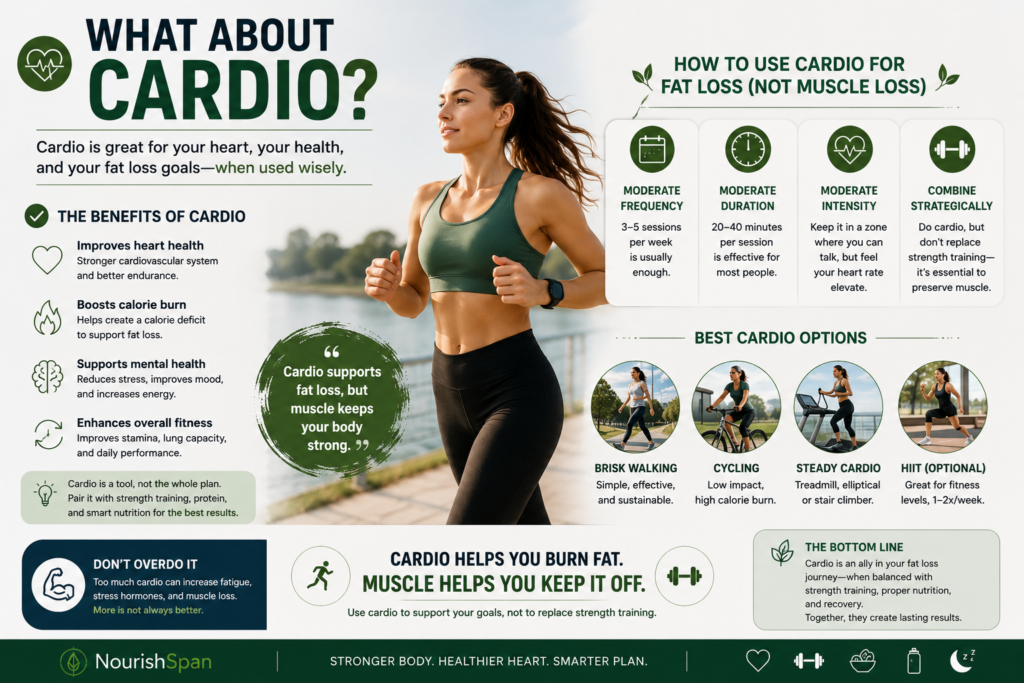
Cardio can absolutely be part of a healthy fat-loss strategy.
It supports cardiovascular fitness and can increase energy expenditure.
But if muscle preservation is a major priority, cardio shouldn’t necessarily replace resistance training.
Evidence from recent systematic reviews suggests that different forms of exercise can contribute differently to fat loss and lean-mass preservation. Resistance training is particularly useful for protecting lean mass during calorie restriction. citeturn0search14turn0search8
A balanced approach can include:
Resistance training
for muscle and strength
Aerobic activity
for cardiovascular fitness
Daily movement
for overall activity
You don’t have to choose only one.
What About GLP-1 Medications?
This is becoming an increasingly important question as medications such as semaglutide and tirzepatide are used for weight management.
The key issue isn’t whether these medications can produce weight loss. The more interesting question is what happens to body composition during that weight loss.
A 2026 systematic review and meta-analysis of 20 randomized controlled trials found that lean mass accounted for a meaningful proportion of weight lost with incretin-based therapies, similar overall to lifestyle interventions. The analysis also found a more favorable lean-mass profile when lifestyle intervention included resistance training. citeturn2view2
That doesn’t mean people should avoid these medications.
It means that nutrition, resistance training and body-composition considerations remain important during significant weight loss, including medically supervised weight-loss treatment.
If you’re taking a prescription weight-loss medication, don’t change your medication, diet or exercise plan based on an internet article. Discuss your individual needs with your healthcare professional.
What About Protein Supplements?
Protein powder can be convenient.
But it’s not magic.
If you’re already getting enough protein from food, adding a supplement may not provide a meaningful advantage simply because it’s a supplement.
Research on protein supplementation and resistance training suggests benefits for muscle-related outcomes, but results depend on the broader diet and training context. citeturn1search2
Think of protein powder as:
A convenience tool—not a requirement.
Whey, soy, pea and other protein products may be useful depending on dietary preferences and individual needs.
Choose products based on ingredients, nutritional profile, dietary requirements and tolerability rather than marketing promises.
Common Mistakes That Can Lead to Poor Muscle Preservation
Mistake #1: Cutting calories too aggressively
A larger deficit isn’t automatically a better strategy.
Mistake #2: Eating too little protein
A low-protein diet can make it harder to support muscle during weight loss.
Mistake #3: Doing only cardio
Cardio is valuable, but resistance training provides a specific stimulus for muscle.
Mistake #4: Ignoring strength
If your weight is falling but your strength and physical function are deteriorating, that’s worth paying attention to.
Mistake #5: Following an unsustainable diet
A diet that works for two weeks but makes you miserable isn’t a successful long-term strategy.
Mistake #6: Obsessing over the scale
Your weight is useful information—not a complete health report.
A Simple Day of Eating for Fat Loss and Muscle Preservation
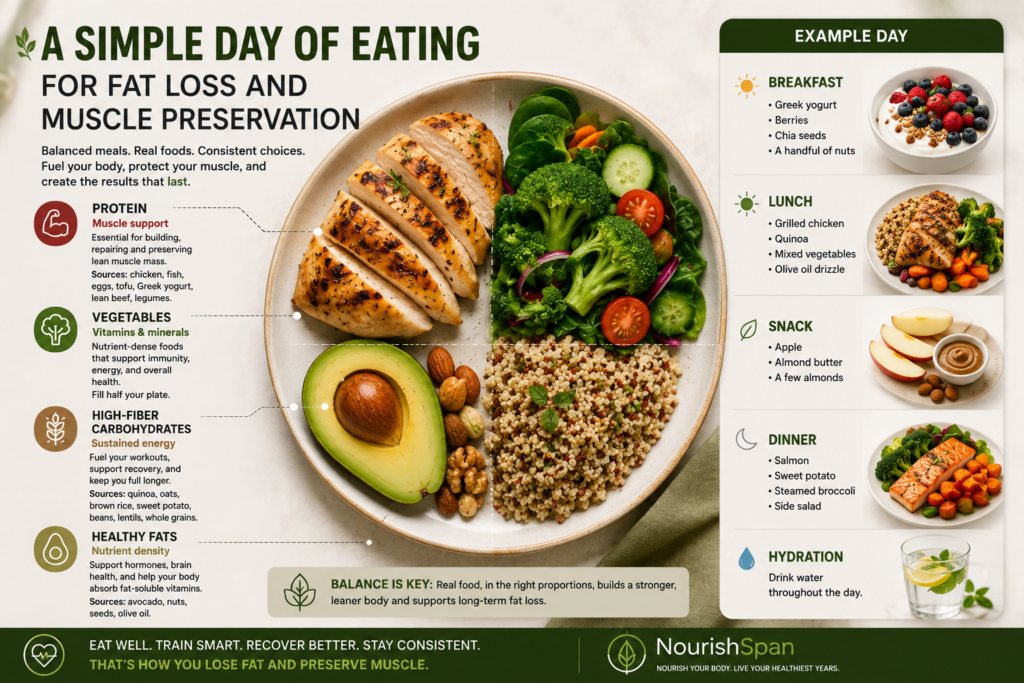
There is no single perfect meal plan, but here’s an example of how you might structure a day.
Breakfast
Greek yogurt + berries + oats + nuts
Protein + fiber + fruit + healthy fats.
Lunch
Grilled chicken + vegetables + quinoa or beans
Protein + vegetables + fiber-rich carbohydrate.
Snack
Cottage cheese or Greek yogurt + fruit
A simple protein-rich option.
Dinner
Salmon + roasted vegetables + potatoes
Protein + vegetables + carbohydrate + healthy fats.
The principle
You don’t need to eat these exact foods.
The goal is to understand the structure:
Protein + plants + fiber-rich carbohydrates + healthy fats
Then adapt the foods to your preferences, culture, budget and dietary needs.
How Do You Know If You’re Losing Fat Instead of Muscle?
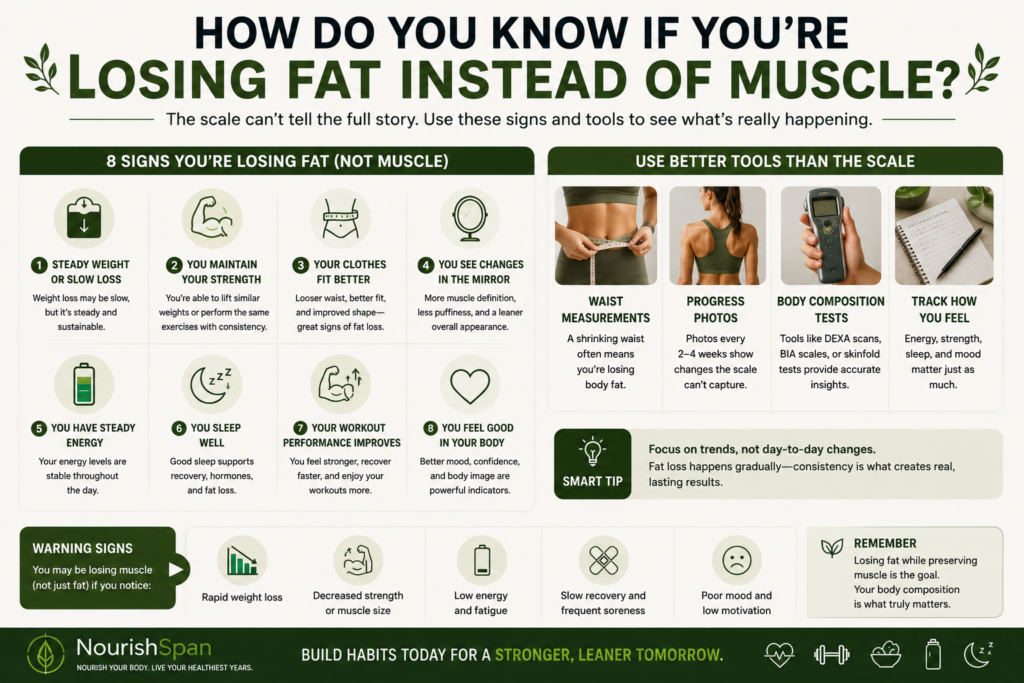
There is no perfect home test.
But looking at multiple indicators gives you a better picture than relying on body weight alone.
Watch the trend in:
Your waist circumference
Is it decreasing over time?
Your strength
Can you maintain or improve your performance?
Your body weight
Is there a gradual downward trend if weight loss is your goal?
Your energy and physical function
Do you feel capable and strong in everyday activities?
Your body composition
If you use a body-composition method, look at trends rather than treating individual readings as exact measurements.
Your Simple Muscle-Preserving Weight Loss Checklist
Use this as a weekly reminder:
- Include a quality protein source in your meals.
- Eat a variety of vegetables, fruits, legumes and whole foods.
- Include resistance training regularly.
- Keep moving throughout the day.
- Avoid extreme calorie restriction.
- Prioritize adequate sleep.
- Monitor your progress beyond the scale.
- Adjust your approach based on your results rather than chasing perfection.
The Bottom Line
Successful weight loss isn’t simply about making the number on the scale smaller.
It’s about improving your body composition, health and physical function while creating habits you can maintain.
The evidence supports a strategy built around:
A sustainable calorie deficit.
Adequate protein.
Resistance training.
Nutrient-dense, fiber-rich foods.
Regular movement.
Sleep and recovery.
Long-term consistency.
You don’t need to punish your body to lose fat.
You need to give it the right conditions to become healthier.
And that’s the bigger idea behind NourishSpan:
Don’t just aim for a smaller body. Build a healthier one that can support you for years to come.
Frequently Asked Questions
Can you lose weight without losing muscle?
You can reduce the amount of lean mass lost during weight reduction, but completely eliminating muscle loss isn’t guaranteed. Resistance training, adequate protein and an appropriate approach to calorie restriction can help preserve lean mass. citeturn0search8turn2view2
How much protein should I eat when losing weight?
Protein needs vary according to body size, age, activity level, training status, health and the size of the calorie deficit. There isn’t one number that applies to everyone. A registered dietitian or healthcare professional can help determine an appropriate target for you.
Is cardio bad for muscle?
No. Cardio provides important cardiovascular and health benefits. The issue is not cardio itself; it’s relying exclusively on cardio when muscle preservation is also a goal.
Should I lift weights while trying to lose weight?
If you’re medically able to exercise, resistance training is one of the most useful tools for helping preserve lean mass during weight loss. Recent systematic reviews support including resistance exercise during dietary weight loss. citeturn0search8turn1search11
How fast should I lose weight?
There is no single ideal rate for everyone. The CDC notes that gradual weight loss—around 1–2 pounds per week for many adults—is more likely to be maintained than faster loss, but individual circumstances matter. citeturn2view3
Can I build muscle while losing fat?
It is possible for some people, particularly beginners or people returning to resistance training, but results vary. A realistic primary goal during weight loss is often to reduce fat while preserving as much muscle and strength as possible.
Do I need protein powder to preserve muscle?
No. Protein supplements can be convenient, but they aren’t mandatory. Whole foods can provide protein, and supplements should be viewed as a practical option rather than a requirement.
Your Next Step
If your goal is to lose fat while staying strong, don’t try to change everything at once.
Start with three things:
1. Build meals around protein and whole, fiber-rich foods.
2. Add consistent resistance training.
3. Focus on sustainable progress rather than rapid results.
Then build from there.
Continue reading on NourishSpan:
The Best High-Protein Foods for Weight Loss and Healthy Aging
What Is Metabolic Health? 10 Signs Your Metabolism Needs Attention
Fiber and Weight Loss: How Much Do You Really Need?
How to Boost Your Metabolism Naturally: What Actually Works
Medical Disclaimer
This article is intended for general educational purposes and is not a substitute for individualized medical or nutritional advice.
Weight management can be affected by medical conditions, medications, hormones, age and other individual factors. If you have a medical condition, take prescription medication, are pregnant or breastfeeding, have a history of an eating disorder, or are considering significant changes to your diet or exercise routine, consult an appropriately qualified healthcare professional.
References & Further Reading
- Binmahfoz A, Dighriri A, Gray C, Gray SR. Effect of resistance exercise on body composition, muscle strength and cardiometabolic health during dietary weight loss in people living with overweight or obesity: a systematic review and meta-analysis. BMJ Open Sport & Exercise Medicine. 2025. citeturn0search8
- Eisa N, Barood O. Lean Mass Changes With Incretin Therapy Versus Lifestyle Intervention: A Systematic Review and Meta-Analysis of Randomised Controlled Trials. Diabetes, Obesity and Metabolism. 2026. citeturn2view2
- Xie G, Gu Z, Li X, et al. Comparing exercise modalities during caloric restriction: a systematic review and network meta-analysis on body composition. Frontiers in Nutrition. 2025. citeturn0search14
- Centers for Disease Control and Prevention. Steps for Losing Weight. Updated January 17, 2025. citeturn2view3
- Kokura Y, et al. Enhanced protein intake on maintaining muscle mass, strength, and physical function in adults with overweight/obesity: A systematic review and meta-analysis. Clinical Nutrition ESPEN. 2024. citeturn1search7